
English| EUR
Suggested for you
More currencies
Choose a language
Roughly 540 kilometres of Altiplano separate Bolivia's administrative capital from the edge of the world's largest salt flat, and most travellers cross it asleep. This uyuni la paz bus guide explains what that journey actually involves — the shape of the schedule, the altitude, the arrival, and how the timing dovetails with tours leaving town. The practical figures live in the sections below; here is the context that makes them make sense.
Quick answer
The Uyuni terminal on Av. Cabrera, between Bolivar St. and Av. 6 de Agosto, operates 00:00–23:59 every day of the week, and there is no terminal fee for the bus route itself — entry is free at 0 BOB. Services concentrate overnight in both directions. Most arrivals land between 05:00 and 08:00, which is also the window tour operators build their departures around.
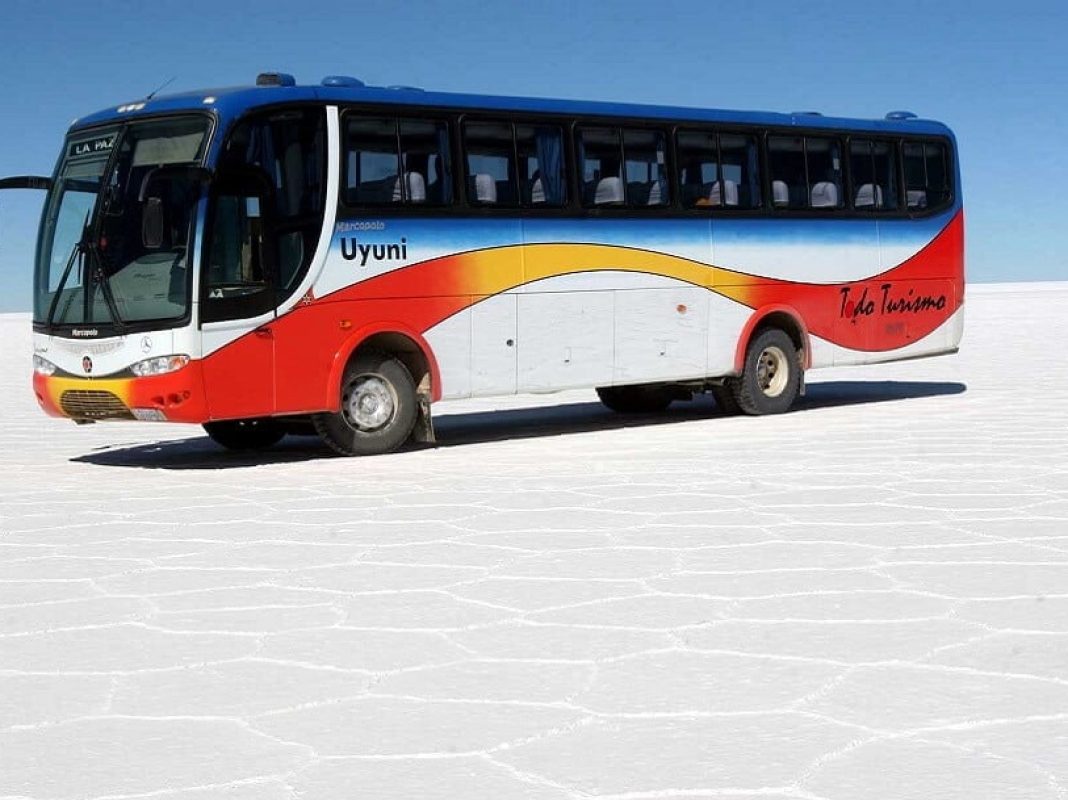
Bolivia's Altiplano does not flatten the journey it appears to promise. The road between La Paz and Uyuni holds above 3,600 metres for almost its entire length, crossing Oruro and the high plains beyond it, and the temperature inside an unheated cabin can fall below freezing while the vehicle is still moving. Seasoned travellers on the uyuni la paz bus board in the clothes they intend to sleep in, not the clothes they wore to dinner. What a reader is actually dealing with here is a night-crossing culture rather than a timetable. Operators cluster their departures in the evening from both ends because the market wants it that way: a bed saved, a day preserved. The consequence is that the route functions less like a transfer and more like a hinge in a longer itinerary. Someone leaving La Paz in the evening is, in practical terms, buying the following morning in Uyuni — and that morning is when the salt flat tours assemble. This is why the bus a la paz Uyuni question so often turns out to be a question about tour timing in disguise. The context that makes the schedule legible is geography plus altitude. Uyuni sits at roughly 3,670 metres; La Paz's El Alto terminal sits higher still. Travellers arriving directly from lower ground frequently underestimate soroche, the local term for altitude sickness, and a long overnight ride does nothing to help acclimatisation. The stretch through Oruro is now largely paved, which has shortened the crossing considerably compared with the gravel era, though wind and dust remain constants and the plains around Río Mulatos offer little shelter. Buses vary widely in cabin class, from basic reclining seats to fully flat cama berths, and the difference matters more at 4,000 metres than it would at sea level. What to do with all this is straightforward enough. Treat the crossing as the first leg of the salt flats trip rather than a separate errand, and plan the Uyuni morning before booking anything. Confirm the terminal address, note the daily access pattern, and understand where the arrival window sits relative to tour pickups — the dedicated sections on this page carry those details in full. Handled well, the uyuni la paz bus becomes the quiet, unremarkable part of a trip whose remarkable part starts a few hours after the doors open.
“The crossing is not a transfer between two cities so much as the first leg of the salt flats trip itself.”
Travelers departing from La Paz typically utilize overnight bus services to reach the Uyuni bus terminal. The station is located on Av. Cabrera between Bolivar St. and Av. 6 de Agosto, Uyuni, Bolivia.
Direct night bus from La Paz Terminal de Buses to Uyuni Bus Station
Bus from La Paz to Oruro, then train/bus to Uyuni
Plan your travel to arrive between 05:00–08:00. This window aligns with the start of daily tour operations and avoids the heat of the midday sun.
The best arrival window for the Uyuni La Paz bus is 05:00–08:00 to align with regional tour departures and avoid mid-day heat. Arriving during this period ensures a seamless transition from your overnight transit to your scheduled excursions.
Cold nights, sunny days (5°C to 15°C)
Ideal for consistent travel and clear skies for salt flat photography.
Mild temperatures, potential rain (10°C to 20°C)
Landscape features water reflections but requires flexible transport planning.
—
Arriving between 05:00 and 08:00 avoids peak mid-day heat and matches local tour operators' start times.
Verdict: Plan your arrival for the 05:00–08:00 window during the dry season months of May through October.
The Uyuni bus terminal operates on a continuous schedule to accommodate passengers traveling between Uyuni and La Paz. The facility remains accessible throughout the week to support various arrival and departure times.
Access to the Uyuni bus terminal does not require an entrance fee. Passengers are only responsible for the cost of their individual bus tickets.
Verdict: The terminal entrance fee is 0 BOB, though total travel costs vary based on the specific bus operator selected for the journey.
A few preparations in the weeks and days before departure make the overnight ride between La Paz and Uyuni far easier to handle.
Everything you need to know about uyuni la paz bus
Travelers typically utilize an overnight uyuni la paz bus to traverse the high-altitude route connecting these two iconic Bolivian destinations. This long-distance trip crosses the Altiplano, allowing passengers to reach the salt flat gateway by morning.
Access to the facility is free, and there is 0 BOB entrance fee for the bus route itself. Travelers do not need to pay a terminal fee when accessing the site.
The best arrival window is 05:00–08:00 to align with local tour departures and avoid the heat of the day. This timing ensures you are prepared to begin your excursion across the salt flats immediately.
While the site provides information on logistics, you should check our booking widgets for available transport schedules for your La Paz to Uyuni bus tour. We do not sell tickets directly but assist in navigating the various operator options.
Yes, the terminal is operational every day of the week, with services running monday through sunday, 00:00–23:59. Frequent connections via luxury sleeper coaches and standard road transport are available for your uyuni la paz bus transit.
Upon arrival at the address on Av. Cabrera between Bolivar St. and Av. 6 de Agosto, you will find yourself centrally located in Uyuni. From here, you can easily connect with local tour providers to start your journey into the vast white landscape.